How to check AI-generated medical questions against your lecture
· 8 min read
TL;DR
A source link is a starting point, not proof that an answer is right. Open the cited page, locate the supporting passage, and check the question, answer, distractors, and explanation separately. If the source does not support a claim, flag it before practising the question again.
AI-generated questions can help you practise your lecture material but an explanation can sound convincing even when the cited page does not support it. Use this checklist before adding a question to your revision set. It checks consistency with a source; it does not establish that a lecture or clinical claim is itself correct.
1. Open the source before judging the answer
Open the exact page attached to the answer. Find the sentence, diagram label, or table cell that supports the tested fact. A link to a relevant-looking lecture is not enough. Check whether the page number refers to the PDF page or a printed slide number.
- Can you find the supporting passage?
- Does it cover the same population, condition, and context?
- Does the explanation add a claim that the passage does not contain?
2. Follow a worked SBA from source to review
Use the public bone-and-joint reference PDF, page 3 of 4, or open the page image. The example below is an edited teaching example based on our existing public demonstration, not a fresh model run or an independent clinical benchmark. It checks agreement with the sample rather than diagnosing a patient.
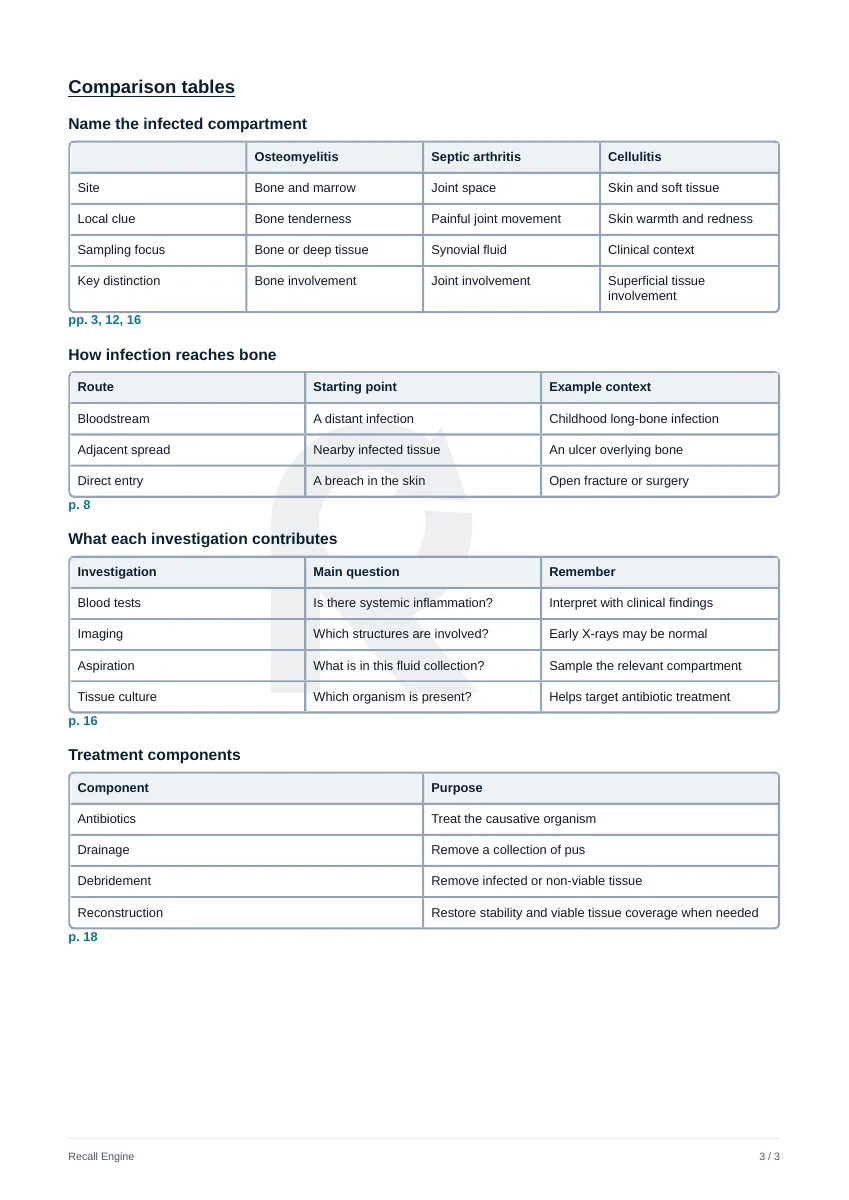
Read the exact source row
| Condition | Site listed in the sample |
|---|---|
| Osteomyelitis | Bone and marrow |
| Septic arthritis | Joint space |
| Cellulitis | Skin and soft tissue |
The small page references printed below the sample table refer to the longer teaching material used to prepare it. For this demonstration, the downloadable file has four pages and the table is on PDF page 3. Do not search this short PDF for a printed reference such as page 12.
Answer before reading the reasoning
Worked single best answer question
A teaching example describes infection confined to bone tissue and marrow spaces. According to the sample table, which condition matches that site? Choose one answer before reading further.
- Septic arthritis
- Cellulitis
- Osteomyelitis
Check the answer and every alternative
| Option | Decision | Source check |
|---|---|---|
| 1. Septic arthritis | Does not match this stem | The table places it in the joint space rather than bone and marrow. |
| 2. Cellulitis | Does not match this stem | The table places it in skin and soft tissue. |
| 3. Osteomyelitis | Best answer for the stated site | The Site row says bone and marrow and matches the information given. |
The explanation should identify the affected compartment. No treatment, investigation result or diagnostic threshold needs to be invented to answer this source-based question. If a generated explanation adds such a claim, that claim needs its own support.
Catch a draft that sounds plausible but fails the source check
Deliberately incorrect draft
Question: According to the table, which condition affects the joint space? Draft answer: Osteomyelitis. Draft explanation: It is an infection near the joint.
The draft confuses proximity with the infected compartment. The table supports septic arthritis for the joint space. Correcting the label is not enough: the explanation must also refer to the joint-space entry. This example checks agreement with the table rather than diagnosing a patient.
Correction supported by the sample
Answer: Septic arthritis. Reasoning: The Site row identifies the joint space in that column. The other columns identify bone and marrow or skin and soft tissue.
Record the check and practise again
- Source: bone-and-joint reference PDF, page 3, Site row.
- Tested fact: the infected compartment rather than a treatment decision.
- Answer support: each option was checked against the same table.
- Revision action: keep only the checked version and answer it again without looking at the row.
For an interactive example, try the existing SBA demonstration. For your own lecture, choose the relevant pages in the SBA workflow, generate a draft, and apply the same checks. Once you have resolved doubtful items, practise saved questions in Custom Test and use Weakness Review to revisit missed topics. Generated wording can differ from this edited example.
3. Check the question and distractors separately
For a single best answer question, the wording must make one option the best choice in the stated context. Plausible distractors should be distinguishable using the information supplied. If two answers remain defensible, flag the question instead of memorising the tool's preferred label.
- Identify what the lead-in actually asks.
- Explain why the selected answer fits that question.
- Check whether each distractor's explanation is supported.
- Watch for an invented age, investigation, or qualifier that changes the answer.
4. Resolve uncertainty before repeated practice
If a source is missing, ambiguous, or conflicts with another reference, keep the item out of your trusted revision set until you resolve it. Ask your educator about course-specific ambiguity and use appropriate current clinical references for medical claims. Do not use a generated practice item to make a patient-care decision.
Record what was wrong and the source used to correct it. Then answer the corrected question from memory. Retrieval practice and spaced review can support learning but repeating an unchecked answer can reinforce the wrong association.
A checklist for your next lecture
- Open the cited page and identify the exact supporting passage.
- Separate the sourced fact from any fictional case framing.
- Confirm that one answer fits the question's context.
- Check the distractors and explanation as well as the answer letter.
- Flag unresolved claims and record corrections.
- Practise the corrected item then schedule another review.
Try the process on the PDF-to-questions example then use your own lecture when you are ready. See pricing for current account and payment availability. This guide and the public sample are available worldwide.
Frequently asked questions
Does a source citation guarantee that an AI question is accurate?
No. Check that the cited passage supports the answer and explanation. A citation can point to the wrong page or fail to support a claim and the source itself may need verification.
What should I do if two SBA options seem correct?
Recheck the lead-in and context. If the source does not resolve the ambiguity, flag the question and ask your educator rather than treating the generated answer as authoritative.
Sources
Keep going
All study guidesProduct and study-guide editors
We build Recall Engine and explain how to use its source-checking workflow. This guide is not an independent clinical review.